
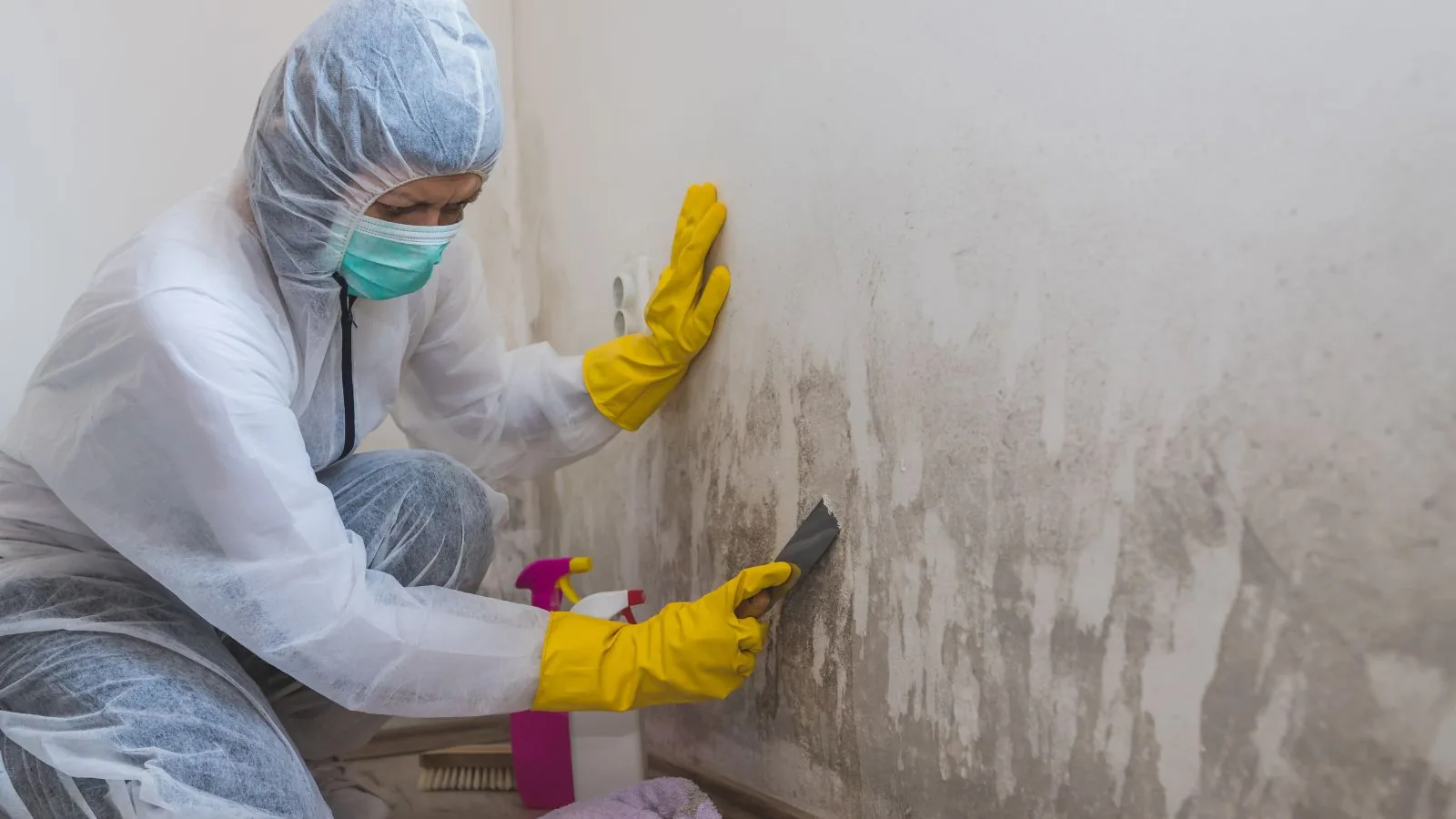
Dark spots on a bathroom ceiling or basement wall are one of the most common reasons Fairhaven homeowners search for help. People call it black mold, but color alone does not tell you what it is, and the first question is always where the moisture is coming from.
This guide covers what you can reasonably clean, what you should leave alone, and the signs that mean it is time to bring in people with containment equipment. It gives no medical advice, and anyone worried about health should talk to a physician.
What black mold actually means
Several kinds of mold look dark green, gray or black, and only a lab can tell them apart. The color does not tell you how serious the growth is. What matters is how much there is, what it is growing on and whether the moisture behind it has been fixed.
The EPA says mold grows where moisture is present, and the way to control it is to control moisture. Surface cleaning without drying the cause usually means it returns.
Small patches on hard surfaces
The EPA says small areas, roughly a few square feet, can often be handled by homeowners on hard, non-porous surfaces like tile and sealed fixtures. Wear gloves, eye protection and a mask rated for the job, keep the room ventilated and use detergent and water.
Do not mix cleaning products, since some combinations release dangerous fumes. Dry the surface completely afterward, and keep watching it for return.
| Situation | Reasonable step | Why |
|---|---|---|
| Small patch on tile or glass | Clean with detergent and water | Hard surface, easy to dry |
| Dark spots on painted drywall | Find the moisture first | Growth may be inside the wall |
| Fuzzy growth on carpet or pad | Stop and call | Porous material cannot be cleaned |
| Large area, more than a few square feet | Call a crew | Needs containment |
| Growth after sewage or flood water | Call a crew | Contaminated water changes the job |
Water on the floor right now?
☎ Call (774) 483-4896What not to do
Do not scrub dry growth hard, sand it, blast it with a fan or paint over it. Disturbing it releases spores into the air, and paint hides a moisture problem instead of fixing it. Do not use a household vacuum without a proper filter.
Do not tear open large wall sections yourself. Opening a wall without containment can spread dust and growth through the rest of the house.
Find and fix the moisture
Growth follows leaks, condensation and high humidity. Check under sinks, around the tub, along the roofline and in the basement. EPA suggests keeping indoor humidity between 30 and 50 percent, and a cheap hygrometer will tell you where you stand.
A plumber or roofer should repair the source. Then a restoration crew can dry what is wet, as the structural drying page explains.
When to call professionals
Call when the area is large, when it keeps coming back, when it sits on drywall, insulation or carpet, when someone in the house has health concerns or when you cannot find the source. Professional work follows the published ANSI/IICRC S520 standard.
The mold remediation page explains containment, removal, drying and clearance in more detail.
Protecting yourself during a small cleanup
If you decide to clean a small patch, plan the job before you start. Open a window or run a fan that blows outward, keep children and pets out of the room and wear gloves, sealed goggles and a mask rated for fine particles. Wear clothes you can wash right away.
Bag the rags and wipes in a plastic bag before you carry them through the house. Wash your hands and any exposed skin when you finish, and wash the clothes separately.
- Dampen the area lightly first so dust does not rise.
- Scrub with detergent and water, not dry brushing.
- Wipe clean with a fresh damp cloth and dry the surface fully.
- Bag and seal everything you used.
Signs the problem is bigger than it looks
Stains on the outside of a wall often hide more on the inside. A musty smell that fills a room, paint that bubbles or peels in sheets, a floor that feels soft near an outer wall and condensation on windows all suggest ongoing moisture.
If you press on drywall and it feels soft or crumbles, the material has been wet for a while and cleaning the surface will not help. That material is usually cut out and replaced after the source is fixed.
Mold conditions in Fairhaven homes
Fairhaven sits on Buzzards Bay with salt air and damp winters, and the town's hazard mitigation plan counts nearly 3,000 of its 7,447 housing units as built before 1940. Older cellars and bathrooms with weak ventilation are common places for moisture to hang around.
If you live in East Fairhaven or on Sconticut Neck, check basement humidity after wet spells. Crews also serve nearby Acushnet and Mattapoisett.
Frequently Asked Questions
Is black mold more dangerous than other mold?
Color does not identify a type. Only a lab can, and the first steps are the same for any growth: find the moisture and limit the area.
Can bleach kill mold on drywall?
Bleach does not fix the moisture and does not reach into porous materials well. Drywall with growth is usually removed.
Does Fairhaven have a rule about mold removal?
Ask the Fairhaven Building Department, and ask whether Massachusetts licenses mold work for your job.
How fast does mold grow after a leak?
EPA guidance says drying within 24 to 48 hours usually prevents growth, so speed matters.
What should I wear to clean a small patch?
Gloves, sealed eye protection and a mask rated for fine particles, plus clothes you can wash right away. Ventilate the room and keep children and pets out.